
My grandfather Kakusaburo Onizuka ⚾️

Updated: May 18

-Early Life-
Although I never met my granddad, it's obvious that he was an athlete. He was born 1907 in Nakatsu, Oita. His father Kichijiro was 55 years old when he died during a job accident building a temple in Nakatsu. That temple is called Myorenji and it still exists today. Not much is known about his mother Yuwa other than he wrote that she was from Shimata, Nakatsu and she came from a farming family.
In his book he writes that growing up he loved sumo wrestling, running, anything exercising. He particularly loved playing baseball from young age. He joined the baseball team in high school and writes that he liked it more than studying, and that it was the only reason he went to school at all. He was recruited by a college baseball player who saw him playing high school baseball. He decided to pick Meiji University because he heard there were good players there from all over Japan.
-College-
My granddad started Meiji University in 1926, and on Sep. 28, 1927 he threw a no-hit game winning 7-0 against Rikkyo University. One of the interesting things about this is that the ball we still have from that game (allegedly) has Hosei University written on it...not sure why. I suppose this is how history gets skewed!

-1931 Tour of Japan-
"Following the 1931 baseball season, a team of Major League All-Stars organized by Herb Hunter and Fred Lieb travelled to Japan for a 17-game goodwill tour. The '31 tour followed in the footsteps of the Tours of Japan in the 1920s. The Americans played 17 games against top collegiate teams and amateur all-star squads, winning all."
On November 9, 1931 the All-American team played against Meiji University. My grandad threw 5 innings as a pitcher, allowing 6 hits against 23 batters. They lost 4-0. Below are the game stats as well as a link with some photos of the American players during that tour.
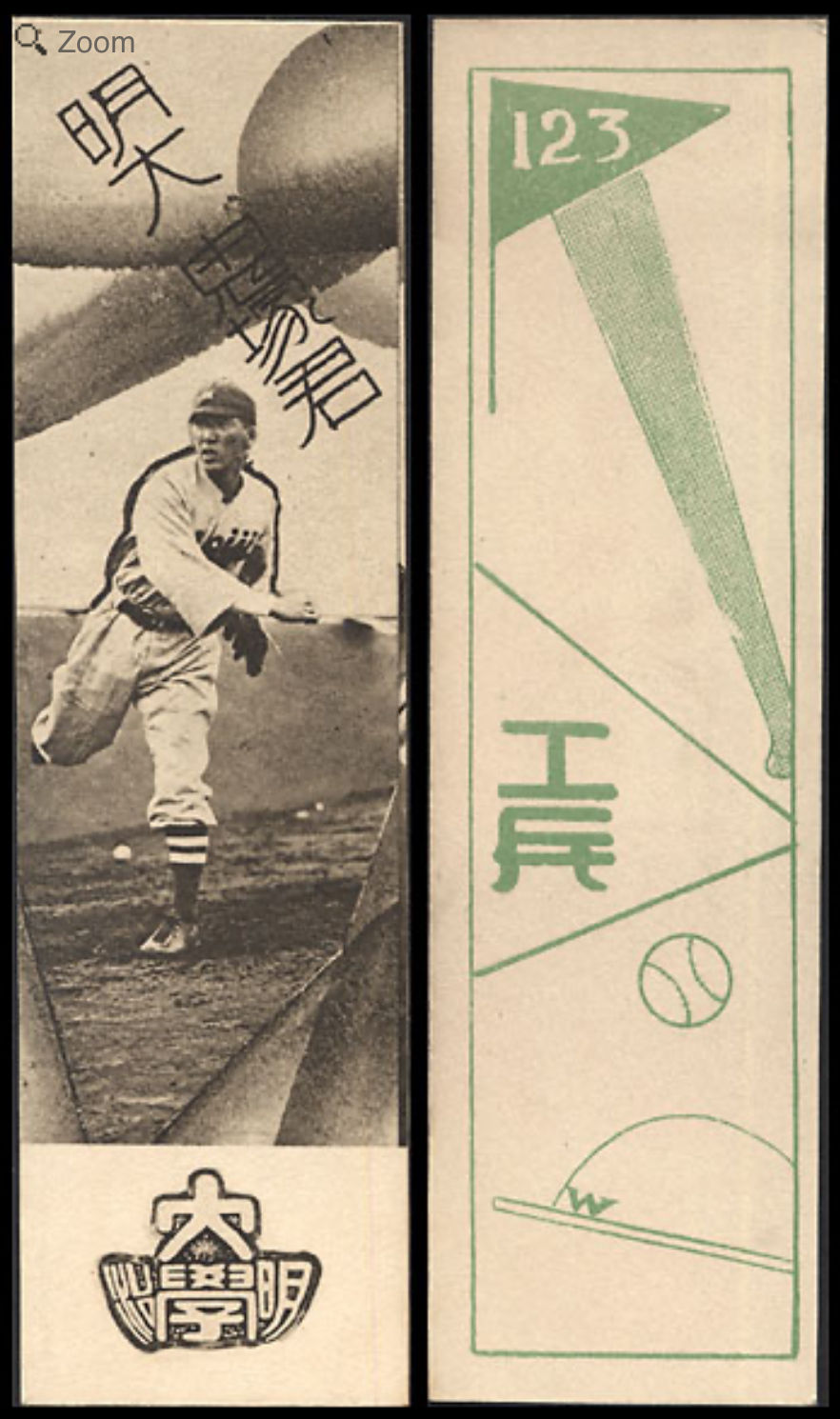
Here are some photos of my granddad in his Meiji uniform. Photos were taken from the below website:
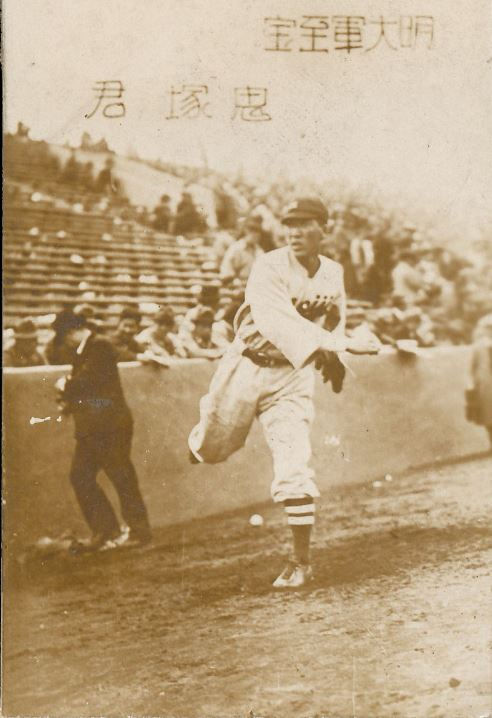
明大 めいだい mei-dai is short for Meiji daigaku, the college he played at.
工兵 こうへい kohei translates to military engineer. Based on what I've read, he wasn't an engineer though.

Meiji University also traveled to Honolulu in 1931 and I was able to find an article about it. I am still looking into this, there is not much information out there about this.
-Post College-
In 1932 he graduated college. After college he went to work at 八幡製鐵所, Yahata seitetsu-sho, in Kita-Kyushu where he was a pitcher and baseball captain (company baseball clubs were amateur baseball leagues then). In 1933 he was called up to the military and trained in Kumamoto for 10 months.
Babe Ruth visited Kokura 11/26/1934 playing against All Kyushu team at Itozu Grounds. It was lightly raining on gameday and Babe played in rain boots, hitting a home run as well, beating All Kyushu 8-1. The below photo is from that day.

My granddad married my grandma on 1935 in Kokura. In 1936 his company's amateur baseball team made it to the Zenkoku Toshi-taiko-sen, 全国都市対抗戦. This is a popular annual baseball tournament among amateur corporation teams. They lost to Moji Tetsudo, but they won the championship the following year. Unfortunately, in 1937 he was called up and sent to China. He was stationed throughout China as an accounting administrator, returning to Japan in 1940. In 1941, he was called up again and sent to Taiwan for 2 months. After that he was moved to the Philippines and was an accounting administrator at a hospital there which was the biggest military hospital outside of Japan.
During his time there, he created a baseball league so that he could continue to play with other baseball lovers. He also picked up tennis while he was there, learning how to play from a young talented child who used to play at the hospital tennis courts. He ended up giving the young tennis phenom a job at the hospital where he worked. That child ended up being Raymundo Deyro, a famous Philippine tennis star. https://en.wikipedia.org/wiki/Raymundo_Deyro
-Coaching Years after the war-
In 1945, my granddad finally returned home from the war. He went back to work at Yahata seitetsu-sho while also coaching the local Kokura high school baseball team. The country was still in ruins after a devastating war, and Kokura was hit heavily by bombs because of the steel factories there. Overcoming these challenges, my granddad managed to build a strong baseball team (stories recounted from his players say he was very demanding to say the least!) that went on to win back to back championships in 1947 and 1948 as a coach for Kokura high school. Below is an excerpt from Wikipedia.
"Crossing the Kanmon Straits- Refers to a championship by a team from Kyushu. The first team to "cross the "Kanmon Straits" between Honshū and Kyūshū was Kokura Secondary in the 1947 Summer Kōshien. Coincidentally, Kokura Secondary repeated as champions in 1948, a feat not matched until Komadai Tomakomai did it in 2004 and 2005, also becoming the first team to bring the title to their region."
My cousin had a chance to see and take photos of the championship ribbons from the Japanese Koshien summer high school tournament which is held every year in Japan.
29th Koshien Baseball (1947)
Kokura Central vs Gifu 6–3
30th Koshien Baseball (1948)
Kokura vs Touin 1–0


List of Summer Koshien Winners and Coaches (かんとく).

The interview is in Japanese, but this person was one of the pitchers in the winning Kokura team, throwing a shutout.
A video about the Kokura high school baseball anniversary celebration.
-After the High School Championships-
From 1946 to 1951 my grandad tried and failed several times to establish his own company. His failed ventures included making baseball bats and gloves, mosquito coil repellant incense, cosmetic cream, and vinyl record player needle. He finally succeeded in 1951, purchasing land at Manazuru to start his own business and to build his home (15 tsubo for the house and 40 tsubo for the office). He was supported by his old baseball contacts he met throughout his life . Mr. Murakami, Kimura, and Kikuchi referred and supported him so that he could get a loan of 30-man (300,000 yen) from the bank. The company he started was called Kokura Kosai KK. Outside of work his continued love for baseball led him to create the Kokura Seiko team in 1950 with him as the coach, and in 1952 this company merged with Sumitomo Kinzoku. In 1954 he became coach of the new Sumitomo Kinzoku team until 1957.
In 1951 he also ran for the city council. There were 121 candidates, and he received 778 votes.

-Later Years-
My granddad's baseball networking helped him out in his later years when he needed support with his business ventures. As his company grew, in 1961 he opened up another office in Wakayama called Wakayama Koka KK. In 1970 Kashima Koka KK was formed expanding his business further.
Outside of business, in 1963 my grandma passed away from liver cancer at 53 years old. As he got older, his love for baseball was replaced by his love for golf.
Below is 1968 Senior Championship Cup at Gifu CC where he shot 40-41-36 117 on day 1; 40-38-40 118 on day 2.
Below is 1970 Senior Championship Cup at Gifu CC where he shot 43-43-40 126 on day 1; 39-41-43 123 on day 2.

In 1971, he placed #1 Kyushu Senior Golf Championship at Miyazaki CC where he shot 41-41-38 120 on day 1; 43-38-39 120 on day 2
#1 Kyushu Inter championship at Fukuoka Kokusai.
In 1972, he placed #2 at Kyushu Senior Golf Tournament.
Below is where he won the senior championship at his local Moji CC from 1968-72.

Below is a 1979 Grand Senior Championship trophy Kyogi Yu-sho 競技優勝

In 1981 he passed away at 73 years old. My father and his brother at his grave in Kokura 2024.


